- Peace and Environment News
- Posts
- Multinational consortium importing thousands of tons of radioactive waste to the Ottawa Valley
Multinational consortium importing thousands of tons of radioactive waste to the Ottawa Valley

Lynn Jones
December 21, 2025
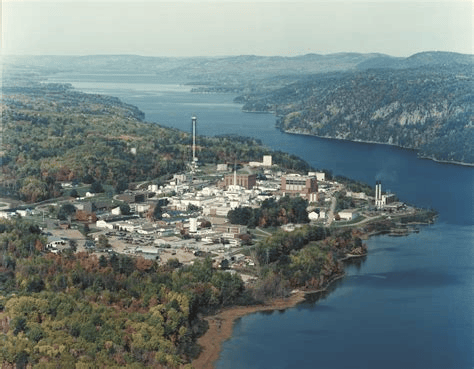
The photo below shows the “active area” at Chalk River Laboratories. The shipping containers and silos full of radioactive waste are located out of the frame, just adjacent to the active area, on the left of the photo. Image Credit: Lynn Jones
The Ottawa River flows through an ancient rift valley that extends from near North Bay through Ottawa toward Montreal. The area is seismically active, and experiences dozens of minor earthquakes each year. Stronger earthquakes also occur such as the magnitude 5 quake in June 2010 that caused shaking, evacuations and damage in Ottawa including shattered windows in Ottawa City Hall and power outages in the downtown area..
Experts say Ottawa is at risk for a big earthquake. The Government of Canada is currently in the process of shoring up and earthquake-proofing the buildings on Parliament Hill. The project will take 13 years and cost billions of dollars.
Incredibly, at the same time as billions are being spent to earthquake-proof Canada’s Parliament Buildings, the Government of Canada is paying billions of dollars to a multinational consortium that is importing large quantities of radioactive waste to the Ottawa Valley.
Soon after it took control of Canada’s nuclear laboratories and radioactive waste in 2015, the consortium, through its wholly-owned subsidiary, Canadian Nuclear Laboratories (CNL), announced its intention to consolidate all federally-owned radioactive waste at Chalk River Laboratories, alongside the Ottawa River, 180 km upstream of Ottawa-Gatineau. There was no consultation or approval from the Algonquin Nation in whose unceded territory the Chalk River Laboratories is located, nor any consultation with residents of the Ottawa Valley about the plan.
CNL is importing nuclear waste from federal nuclear facilities in Manitoba, southern Ontario and Quebec. The imports comprise thousands of shipments and thousands of tonnes of radioactive debris from reactor decommissioning, and dozens of tonnes of high level waste nuclear fuel, the most deadly kind of radioactive waste that can deliver a lethal dose of radiation to an unprotected bystander within seconds of exposure.
High level waste shipments from Becancour, Quebec, have already been completed. They involved "dozens of trucks" and convoys operating secretly over several months, from December 2024 through July 2025, under police escort, to move 60 tons of used fuel bundles to Chalk River. Tons of high level waste from Manitoba will follow soon.
Since there is no long-term facility for high level waste at Chalk River, nor is there any such facility anywhere in Canada at present, CNL built silos (shown in the photo below) to hold the waste at a cost of 15 million dollars. This high level radioactive waste is ostensibly in storage at Chalk River, but there is no guarantee it will ever be moved.
Image Credit: Open Canada (Source p.222)
CNL plans to put some of the less deadly waste into a giant above-ground radioactive waste dump called the NSDF, a controversial project currently mired in legal challenges. The dump would hold one million tons of radioactive waste in a facility designed to last about 500 years. Many of the materials destined for disposal in the dump, such as plutonium, will remain radioactive for far longer than that. According to CNL’s own studies, the facility would leak during operation and disintegrate after a few hundred years, releasing its contents to the surrounding environment and Ottawa River less than a kilometer away.
Shipping containers filled with radioactive waste are piling up at Waste Management Area H on the Chalk River Laboratories property, awaiting a time when they can be driven or emptied into the NSDF. At last count there were 1500 shipping containers there, shown in the photo below.
Image Credit: Concerned Citizens (Source)
It would be hard to choose a less suitable place to consolidate all federal radioactive waste than in a seismically-active zone beside the Ottawa River that provides drinking water for millions of Canadians in communities downstream including Ottawa, Gatineau and Montreal.
Concerns about imports of radioactive waste to the Ottawa Valley are widespread and growing rapidly. They include the risks of transporting radioactive waste on public roads.
In 2021, Ottawa City Council unanimously passed a resolution calling for (among other things) radioactive waste imports to the Ottawa Valley to stop.
Ottawa Riverkeeper recently called for transportation of radioactive waste to the Chalk River Laboratories to stop until a clear, long-term plan for the waste is available.
In December 2025, Members of Parliament from the Bloc Québécois and Green Parties along with First Nations and many civil society groups wrote to Prime Minister Mark Carney requesting (among other things) a moratorium on shipments of Canadian radioactive waste to Chalk River.
Hopefully these growing concerns, loudly voiced, will wake up decision makers and radioactive waste imports to the earthquake-prone Ottawa Valley will be halted in the near future.
Reply