- Peace and Environment News
- Posts
- November / December 2025
November / December 2025
Ottawa Hunger Report; Radioactive Waste; Municipal Budget

Christopher Bonasia
December 22, 2025
Hello,
Happy Holidays.
This year’s Ottawa Hunger Report from the Ottawa Food Bank frames rising food insecurity across the city within a larger context of families and individuals struggling with general affordability issues.
“This year, Ottawa’s food insecurity emergency made one thing impossible to ignore: multiple systems are broken.”
The statistics detailing Ottawa’s food insecurity in 2024, the most recent full year of data, paint a startling picture, with one in four households experiencing food insecurity “as a result of policy decisions that are failing all Canadians.”
Of those that turned to Ottawa’s network of food banks, 40% of visitors were single adults, 9% were seniors, 29% were two-parent families, 16% were single-parents families, and 32% were newcomers to Canada (these numbers are not meant to add up to 100% because some groups overlap, and some visitors don’t fit in any of these groups). Food bank visits by seniors—a group that will include one in every five Ottawa residents by 2030—have already risen 90%. The rate of newcomers visiting foodbanks is also going up, and 80% of newcomers turning to food banks have been in Canada for two-years or less. This “is not a reflection of their ability to contribute or their right to receive supports, but of barriers and inequities built into Canada’s settlement, employment, and social support systems,” the food bank says.

Image Credit: Ottawa Food Bank, 2025 Ottawa Hunger Report
Meanwhile, 20% more two-parent families visited food banks from the year before, with many families earning just above the threshold for income-based assistance. “Many of these households are working, renting, and raising children, but cannot keep up with the rising costs of housing, childcare, and daily essentials,” the report says.
“Food insecurity is not inevitable. Broken systems create it, strong systems end it.”
The Food Bank says the rise in food insecurity is linked to Ottawa residents facing financial pressures across all aspects of their lives, while support remains inadequate. Housing costs are among the strongest drivers—median monthly rents have increased 61.3% since 2006, while wages have not kept up. Rising costs for everyday essentials and unaffordable (and unreliable) public transit make matters even worse.
At the city level, addressing food insecurity requires policies that improve access to affordable housing and transit while working towards an established target to ending food insecurity, says the report. The Ottawa Food Bank also calls on the Ontario government to step up by raising social assistance rates, investing in housing and rent supports, protecting residents from losing benefits, and modernizing the province’s poverty strategy.
Stories from the PEN!
This month’s stories from the PEN include:
Lynn Jones writes about a Multinational consortium importing thousands of tons of radioactive waste to the Ottawa Valley.
City Council already approved the budget on December 10, but this late-November rundown from Ecology Ottawa in What’s in the 2026 Budget? is still informative, and worth a read.

The photo below shows the “active area” at Chalk River Laboratories. The shipping containers and silos full of radioactive waste are located out of the frame, just adjacent to the active area, on the left of the photo. Image Credit: Lynn Jones
From the PEN Archives
The December 1997 PEN edition, the Campaign for a Nuclear Phaseout wrote about an upcoming shipment of plutonium due to travel to the Atomic Energy of Canada Limited (AECL) laboratories at Chalk River for a "test burn" in a nuclear reactor, “as part of a plan by AECL and Ontario Hydro to import 100 tonnes of weapons plutonium from nuclear stockpiles from the United States and Russia.”
“Without any public consultation or parliamentary debate Prime Minister Chrétien has declared that Canada supports the plan in principle. This is quite a change from several months ago, when the Department of Natural Resources stated that the approval process would include full public review of the proposal. The Campaign for Nuclear Phaseout is opposed to the import and use of plutonium fuel for a number of reasons. It will not turn ‘swords into ploughshares.’ Instead, it will help launch a deadly global plutonium economy by in-creasing the accessibility and potential for proliferation of this nuclear explosive.”
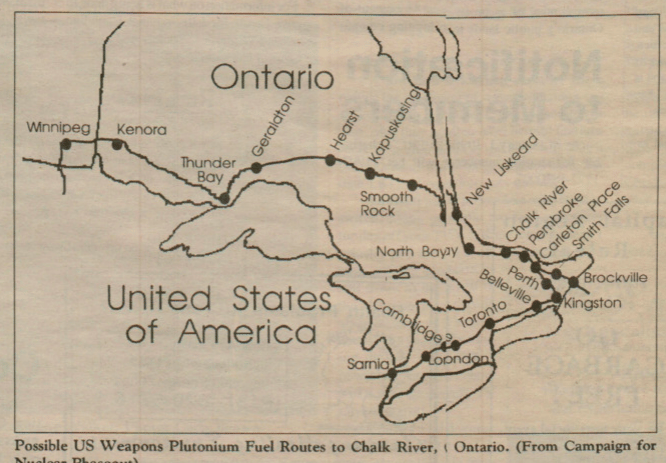
Peace & Environment News, December 1997
Other News
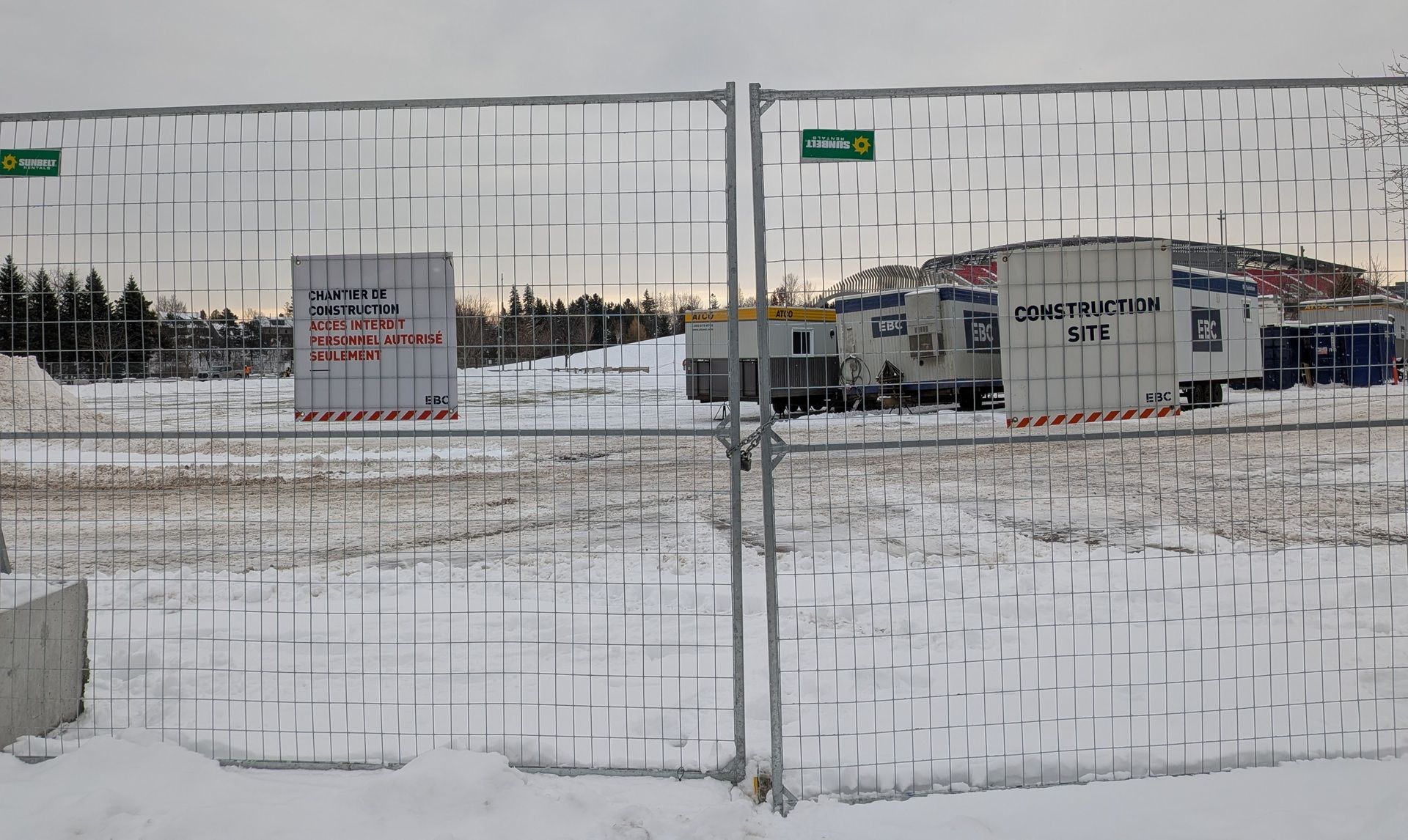
The ink on the decision approving Landsowne 2.0 had barely dried before the greenspace and berm were blocked off for construction. Image Credit: C. Bonasia
A reduction in the multi-residential tax ratio for buildings built prior to 2001 means that thousands of Ottawa renters will see rent reductions as of January 1, reports CTV News.
Derryn Shrosbree, a farmer and advocate, told CTV Your Morning that farm succession rules should include an exemption for nieces and nephews in order to keep farms operating.
Ottawa’s Planning and Housing and Agriculture and Rural Affairs committees recommended that Council approve the final draft of the new Zoning By-law, which the City says is intended to help address housing issues and population growth.
The Information and Privacy Commissioner of Ontario, the provincial government transparency watchdog, is intervening after “several instances in recent years” that the province’s Solicitor General has ignored decrees to release information, reports Global News.
According to the Kingston Whig Standard, local grain farmers were hit hard by this summer’s drought, with some seeing yields 30-40% below normal.
With wells still recovering slowly from a dry summer and fall, Ottawa’s municipal government is asking that landowners who rely on private wells for water do not create backyard skating rinks this winter, says CTV News.
Environment and Climate Change Canada launched a new alert system to help protect Canadians in extreme weather events. The color-coded system will help make extreme weather severity and risks easy to understand, Global News says.
The City of Ottawa is considering buying the private Capital Region Resource Recovery Centre—the “first and only landfill approved” by the Ontario government in over two decades—to help meet future garbage disposal needs, says CTV News.
I look forward to connecting with you again next month through the PEN Newsletter. In the meantime, please use the comments section of the newsletter or email [email protected] with thoughts or questions.
—Christopher Bonasia, PEN editor
PERC appreciates all of our readers for giving us this chance to connect with members of our community, and we love being able to provide you with a forum to discuss pressing environmental and social justice issues.
But we also rely on your support to make this happen. If you are interested in helping our organization continue to use storytelling and networking to help individuals, non-profits, and community groups work locally for a greener and more peaceful world, please consider making a donation to the Peace and Environment Resource Centre.
Reply